
Floyd County Sex Offender Checks
Start with the official Iowa Sex Offender Registry. The Iowa Division of Criminal Investigation maintains it for public safety and community awareness. It is the best route for a current profile, because the state view can show aliases, a photograph, the qualifying offense, tier, compliance status, and a residence, work, or school location when the law permits publication.
Floyd County offers a second path through its Current Floyd County SOR list. The county page was dated June 9, 2026 when researched. It gives a quick local scan of names, birth dates, and Floyd County residence or work addresses. That list is useful, but it is a snapshot. Open the state profile before relying on a county-list entry, especially when status or an address may have changed.
Channel flow: Floyd County list › Iowa registry profile › Floyd County Sheriff's Office confirmation.
Floyd Registry Redesign Tools
The Iowa Department of Public Safety announced a redesigned registry on August 22, 2025. The update kept the same public address while adding wider search choices, search tips, interactive maps with registrant counts, direct links for active and most-wanted registrants, personalized watches, and safety material for Floyd County users. The official registry redesign announcement shows the source behind that change.
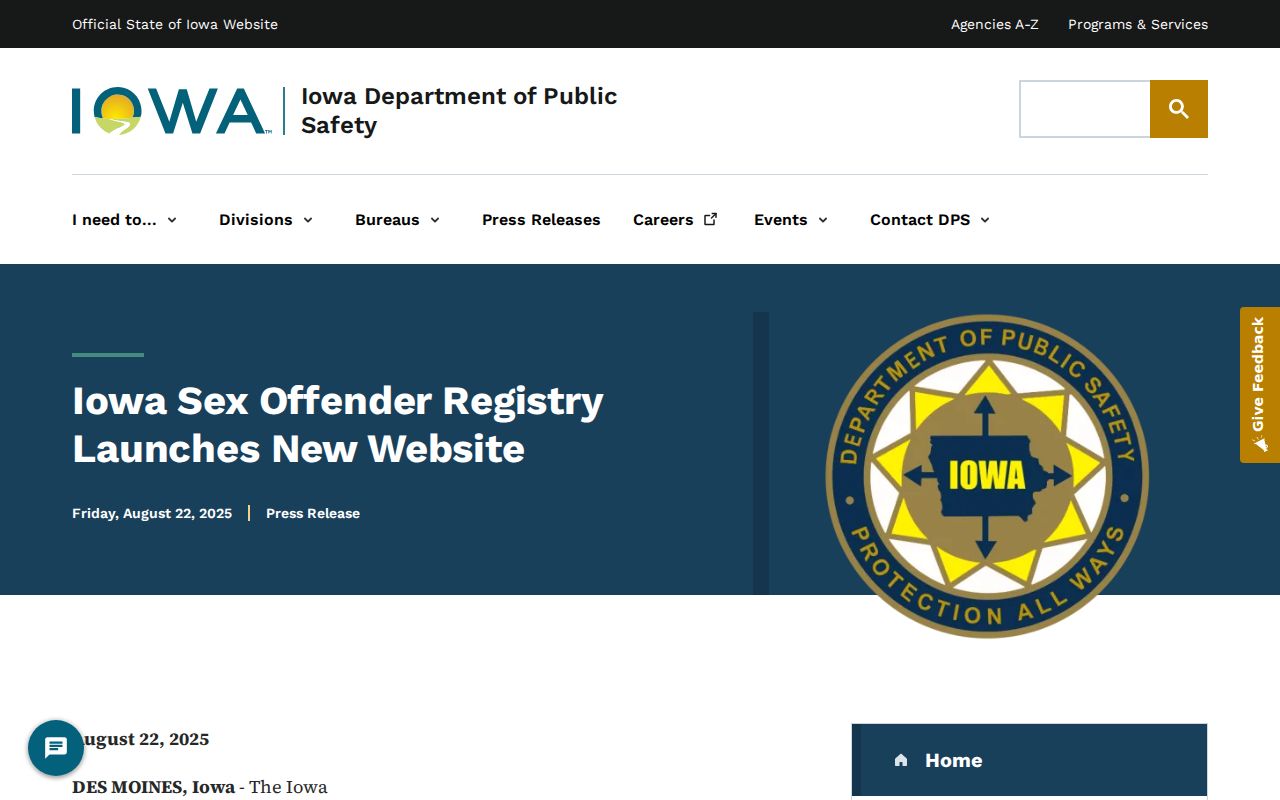
The announcement helps explain why an older set of registry instructions may not match the live controls. Use the site's current navigation rather than an archived screen description.
Iowa Sex Offender Registry Searches
The public registry requires agreement to its terms before Floyd County results appear. Search by a known name when possible. Turn on the alias option when a former or alternate name may matter. For a place-based Floyd County sex offender lookup, use the county, city, or ZIP controls, then review the map and list together. A map point is a search aid, not proof of new conduct at that place.
- Open the official Iowa registry and select the control to agree to its terms.
- Enter a last and first name, or choose Floyd in the county field for a broad local view.
- Use aliases, city, or ZIP to test another reasonable form of the search.
- Open the profile and read its status, offense, tier, listed locations, and update cues.
| Field label | Type | Required | Use |
|---|---|---|---|
| Last Name | Text | Unspecified | Search a registrant surname |
| First Name | Text | Unspecified | Narrow a name result |
| Also Search Aliases | Checkbox | No | Include alternate names |
| ZIP Code or City | Text | Unspecified | Narrow by place |
| County | Dropdown | No | Select Floyd from all Iowa counties |
Most Wanted and Notifications/Watches are separate parts of the state system. A search result describes registration information. It does not replace the public court docket for the underlying case.
Two Floyd Registry Views
The county and state views answer different questions. Floyd County's plain list is fast when the goal is to see who has a listed residence or work connection in the county. The Iowa registry is stronger when identity, current compliance, aliases, a qualifying offense, or tier duties matter. A person may appear because of work rather than residence, so read the location label instead of assuming the address is a home.
The state portal should control when the two views seem out of step. Confirm the update and status fields, then call the sheriff if a material local fact still looks wrong. Do not confront a listed person or household. A stale-looking result may reflect reporting and review timing, not an intent to evade the law.
Note: A Floyd County registry entry is not a complete criminal history or a statement about anyone else at the listed address.
Registry Profiles: What They Show
A public Iowa profile collects facts needed to identify a registrant and understand the legal duty behind a Floyd County result. It is narrower than a rap sheet. The profile can identify the offense that created the duty, but it does not reproduce every motion, order, or event from the criminal court file. For that case-level detail, use the contextual Floyd County court case lookup.
| Name and aliases | Legal name plus alternate names published by the registry |
|---|---|
| Photo and description | Photograph, sex, race, age or birth date, height, weight, hair, eyes, and published marks |
| Listed locations | Residence, work, or school information to the extent Iowa law allows |
| Qualifying offense | Offense description, jurisdiction, conviction date, and victim-age category when authorized |
| Tier and status | Tier, registration or compliance state, and update indicators |
| Other public details | Vehicle information or noncompliance context when the registry publishes it |
Read every label. Similar names are common, and an alias match alone cannot establish identity. The profile's status and dates help distinguish an active duty from an old or mistaken assumption.
Floyd Searches and NSOPW
The Iowa registry is the right first stop for a person or address tied to Floyd County. When a person may live, work, study, or travel beyond Iowa, the national layer can extend the search. The U.S. Department of Justice's National Sex Offender Public Website supplies the official cross-state source shown here.
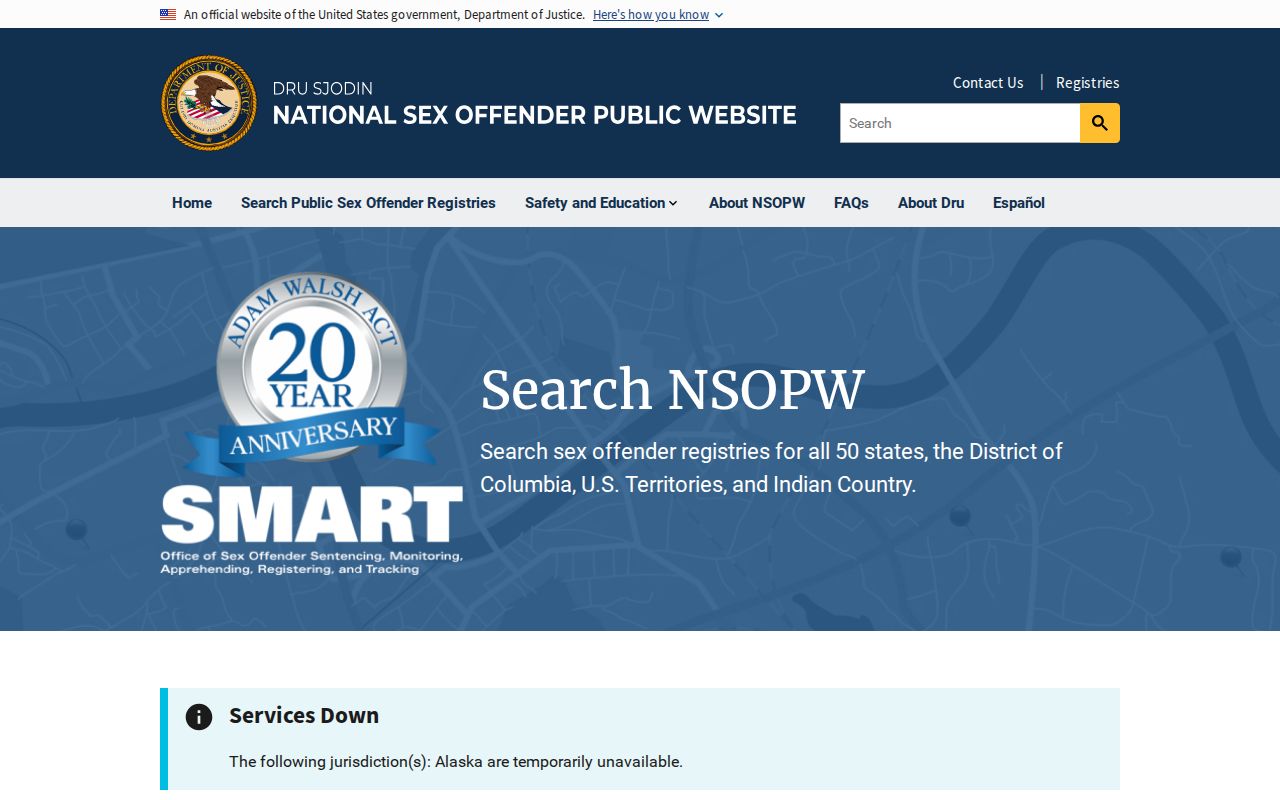
Return to the Iowa profile for the precise Iowa entry and local reporting context. Neither route should be treated as an unchanging address book.
Registration Levels and Duties in Iowa
Iowa assigns Tier I, II, or III mainly from the qualifying offense under chapter 692A. The tier is not a casual rating of what someone might do in the future. It sets a baseline for the reporting period and how often the person appears in person for verification. Floyd County registrants complete that local verification through the Floyd County sheriff.
| Iowa tier | General period | Routine in-person verification |
|---|---|---|
| Tier I | 10 years | Annually |
| Tier II | 10 years | Every six months |
| Tier III | Lifetime | Every three months |
These are baseline rules. The offense, repeat status, another jurisdiction's duty, a juvenile adjudication, or a court order can alter the result. Changes to covered information generally must be reported within five days and acknowledged. Iowa Code chapter 692A, including section 692A.128, controls the limited court-modification route and its conditions.
Floyd County Registration Office
The Floyd County Sheriff's Office keeps local sex offender records and handles in-person verification at 101 S. Main Street, Suite G132, Charles City, IA 50616. The published number is 641-228-1821, and office hours are Monday through Friday, 8:30 a.m. to 4:00 p.m. Call before a visit to make sure the right staff member is available, or use the county's sheriff staff directory to confirm the local office channel.
Floyd County Sheriff's Office
101 S. Main Street, Suite G132
Charles City, IA 50616
641-228-1821
Monday-Friday, 8:30 a.m.-4:00 p.m.
Report suspected noncompliance or a serious local address concern to the sheriff. Registry policy questions can also go to DCI at 515-725-6050 or sorinfo@dps.state.ia.us. Use 911 only for an emergency, not for a routine profile question.
Floyd Registry Maps and Address Rules
Iowa Code section 692A.114 applies a 2,000-foot residence limit near schools and child-care facilities to specified offenders, subject to statutory exceptions. Section 692A.113 addresses exclusion zones and certain activities. These limits do not apply in the same way to every person on the Floyd County registry. The exact offense and current statute control.
A Floyd County map pin also has limits. It can reflect a home, job, or school location published under law, and it does not show that a fresh offense occurred there. Check the Floyd County profile's location type and status. If a point seems wrong, use official reporting channels rather than making an accusation based only on the map.
DCI and Floyd Registry Records
The Iowa Division of Criminal Investigation manages the statewide registry and the central criminal-history repository used for Floyd County records. Those products are related but distinct. Floyd County registration is triggered by a qualifying adjudication and chapter 692A duties. A DCI criminal-history record compiles releasable fingerprint-supported arrest and disposition data. The official Iowa DCI page is the source shown below.
This agency role is why state registry questions go to DCI, while local verification and suspected Floyd County noncompliance go to the sheriff.
Using Registry Information Lawfully
Use Floyd County sex offender data for personal safety, family planning, and lawful community awareness. Verify a profile through the official system and consider its listed connection, tier, status, and update information. Registration reflects a qualifying adjudication and an ongoing legal duty. It does not prove a new offense at the published address.
Misuse warning: Under Iowa Code chapter 692A and the registry's terms, information must not be used for harassment, threats, intimidation, vigilantism, or unlawful discrimination. Misuse may be a crime.
Household members and neighbors are not registrants merely because they share or live near an address. When safety requires action, contact law enforcement. Do not seek independent punishment or public confrontation.