
Criminal Court Cases in Floyd County
Floyd County belongs to Iowa Judicial District 2. The Iowa District Court has general jurisdiction and hears felony prosecutions. Associate district judges and magistrates handle assigned misdemeanors, preliminary proceedings, scheduled violations, and other matters allowed by Iowa law. These are parts of one unified district court system, not separate local databases. The Judicial Branch Floyd County directory identifies the local court and clerk route.
The county lists District and Associate District Court on the courthouse third floor and Magistrate Court on the fourth. District Court day is every other Monday. Associate District Court meets Tuesday mornings, while Magistrate Court days are Monday, Wednesday, and Friday from 9:00 a.m. to noon. Those regular court days do not guarantee that a particular Floyd County case appears on a given calendar. Confirm a hearing through the docket or clerk.
Floyd County Criminal Case Clerk
The Floyd County Clerk of Court is the custodian of filed court records. The criminal desk is in Suite 403 at 101 South Main Street, Charles City, IA 50616. Call 641-228-7777, fax 641-228-7772, or email countyclerk.floyd@iowacourts.gov. Public hours are weekdays from 8:00 a.m. to 4:30 p.m. The clerk can route a request for a docket sheet, plain copy, certified judgment, sentence, or public exhibit, though staff cannot give legal advice.
The official Floyd County clerk page shows where local court service starts. The manifest image below captures that source without displaying a private case.

The local counter matters when an entry is old, archived, not imaged, or too unclear to resolve from the web view. Floyd County does not publish current criminal copy fees or archive coverage, so ask for an estimate and state whether certification is required.
Floyd County Case Record Searches
Iowa Courts Online Search is the main public index for Floyd County criminal case records. A name search can produce same-name results from across Iowa, so the Floyd county filter is essential. Search each prior name or initial separately, open every plausible Case ID, and compare filing dates and offense dates. Free access does not expose every document. Some links work only through a courthouse terminal or paid subscription.
- Open the trial court search and choose the party-name or exact case-number route.
- Enter the legal name, then set County to Floyd and use the criminal case type where offered.
- Open the Case ID and note each charge, filing date, offense date, and status separately.
- Read docket events for amended charges, warrants, pleas, deferred-judgment discharge, judgment, or appeal.
- Ask the Floyd County clerk for the signed or certified final order when proof of the outcome is needed.
| Field Label | Type | Required | Notes |
|---|---|---|---|
| Case Number | Text | Alternative key | Enter the Iowa identifier exactly when known. |
| County | Dropdown | No | Select Floyd to cut statewide same-name results. |
| Case Type | Dropdown | No | Select criminal when the control is offered. |
| Last Name | Text | Name route | Run aliases and former surnames separately. |
| First Name | Text | No | Use the full first name and test initials if needed. |
Floyd County Docket Search Limits
An online docket is an index of court activity, not the full clerk file. A free Floyd County result may show a filing, event, or document label without the underlying PDF. Protected filings, sealed material, confidential juvenile matters, and older paper records will not become public merely because a name was searched. The official Iowa Courts Online search guide explains the distinction between public links and access limited to clerk terminals or subscribers.
The official Iowa court search interface is shown in the assigned image. It is a starting point, not a certified result.
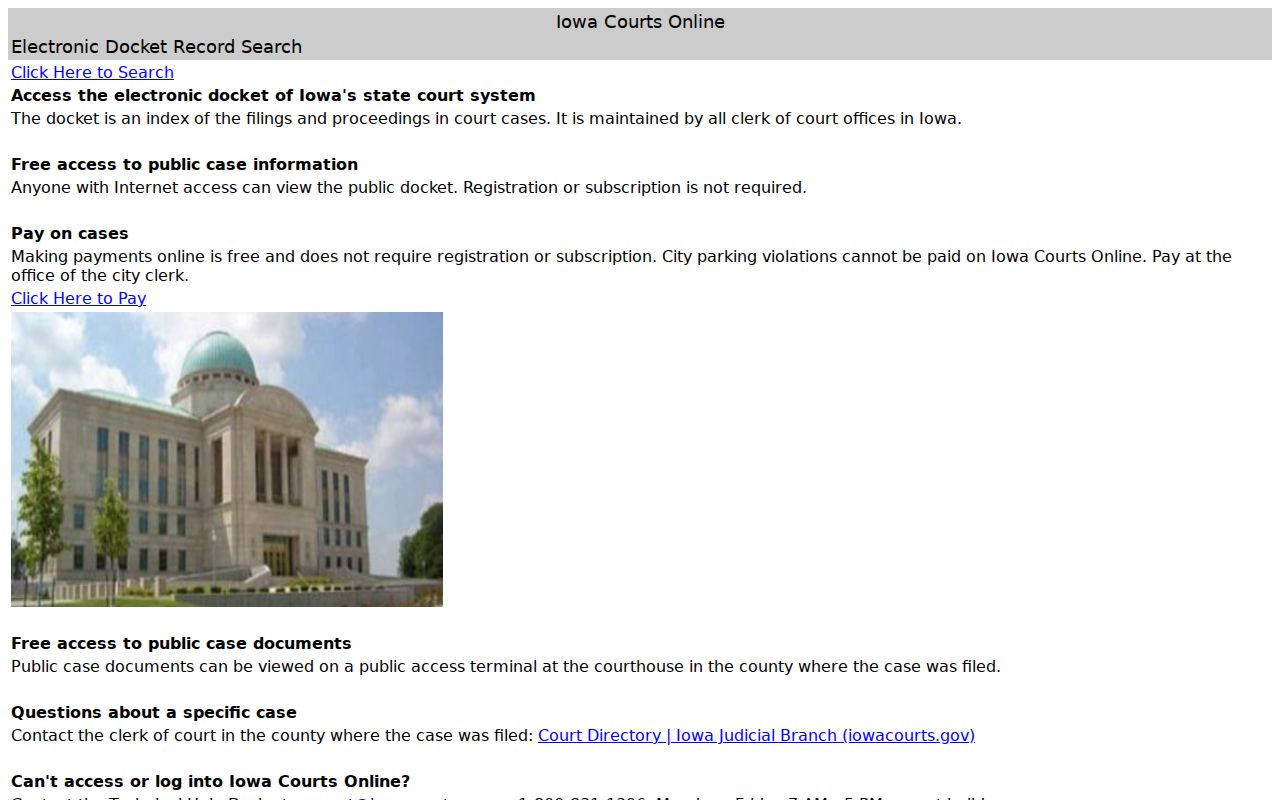
A missing Floyd County case can reflect a spelling issue, pre-electronic record, archive location, sealed or expunged file, confidential juvenile case, or a matter never filed in this county. Call the clerk with the name, approximate year, and any case number before concluding that no case exists.
What a Criminal Case File Contains
A Floyd County criminal case file tracks the judicial case from the filed accusation through its outcome. It does not reproduce the full police narrative or jail record. The most useful item depends on the question. A docket sheet traces events, a charging document states the filed allegation, and a signed judgment or dismissal order proves how a count ended. Read every count because one case may contain different outcomes.
| Case Number & Court | Identifies the Floyd County case, case type, filing date, and court division. |
|---|---|
| Charging Document | Shows the complaint, trial information, or indictment and the Iowa Code provisions alleged. |
| Docket Entries | Lists filings, counsel appearances, orders, motions, continuances, warrants, and closure events. |
| Hearing Dates | Shows public settings, event type, time, and judicial officer or location when available. |
| Disposition & Judgment | States whether each count was dismissed, acquitted, deferred, or resolved by conviction. |
| Sentence & Conditions | Records custody, probation, fines, costs, restitution when public, and other court terms. |
A DCI rap sheet is different. It assembles fingerprint-supported arrest cycles and reported outcomes, while the Floyd County court file holds pleadings, motions, orders, and the signed final decision.
Read Floyd County Case Outcomes
Case-level words can mislead. “Disposed” means the case is no longer pending, but it does not state the result of each charge. A count may be dismissed, amended, transferred, acquitted, resolved by a guilty plea, or found guilty at trial. A deferred judgment is not a conviction after successful discharge, yet DCI says the discharged event remains in its repository as a non-conviction and has special release limits.
- Disposition
- The final result for one charge, not merely the case-wide status.
- Arraignment
- The stage when the accused is formally called to answer the filed charge.
- Trial information
- The prosecutor's formal charging instrument for an indictable Iowa offense.
- Deferred judgment
- A court outcome that can become a non-conviction after successful discharge.
- Certified judgment
- A clerk-authenticated copy of the signed court decision.
When the result carries weight, obtain the final order from the Floyd County clerk. A portal status alone is not a substitute for the signed judgment.
Floyd County Court File or Rap Sheet
Choose the record by the question. A Floyd County court file answers what prosecutors filed, what motions and hearings occurred, and how each count ended. It can supply the signed judgment or dismissal order. An Iowa DCI rap sheet answers which fingerprint-supported arrest cycles and reported outcomes are releasable for a person across the state. It does not include each pleading, hearing notice, or court document.
The products can disagree without either being false. A court disposition may not yet have matched the DCI arrest cycle, or an arrest may lack submitted fingerprints. DCI release rules can also withhold some nonconviction information. Compare case number, charge, arrest date, and disposition date, then ask the correct custodian to review the record it controls.
Criminal Case Stages in Floyd County
A Floyd County case begins in court after a complaint, citation, trial information, or indictment is filed. An arrested person must appear before a magistrate without unnecessary delay. The magistrate addresses identity, the accusation, counsel, release or bond, and preliminary-hearing rights. The Floyd County Attorney may then file or amend charges. Arraignment is followed by discovery, motions, and pretrial work before a plea or trial.
Case flow: Charges Filed › Arraignment › Pretrial › Plea or Trial › Disposition › Sentencing
Judgment and sentencing are separate events. An appeal may move into Iowa's appellate courts, while the Floyd County docket keeps the lower-court record of the notice and later action. Arrest charges can differ from the filed charge, and both can differ from the final conviction. That sequence is why the court file must be read chronologically.
Floyd County Court Warrant Entries
A docket entry saying “warrant issued” does not prove that the warrant is active now. Later entries may show service, recall, or quashing. The Floyd County Sheriff maintains active county arrest warrants, while the clerk reports public court status. Search the underlying case, note the warrant and case identifiers, then confirm current status by calling the sheriff at 641-228-1821 and the clerk at 641-228-7777.
Sealed warrants, juvenile matters, and investigative or search-warrant material may not appear. Neither office can advise a person how to evade service. If action is required, verify the issuing court and seek legal advice about a safe appearance.
Access Rules for Case Records
Iowa court access is governed by state law, court rules, and case-specific orders. Iowa Code chapter 692 controls criminal-history data, while the Iowa Open Records Law governs many agency records. Court records follow Judicial Branch access rules rather than becoming fully open under a broad request to the sheriff. Juvenile files, sealed or expunged records, protected victim details, Social Security numbers, and other confidential data do not appear in an ordinary Floyd County search.
The web view may redact fields that exist in the official file. Ask the clerk whether a public document can be inspected or copied, and request an estimate because Floyd County's current criminal copy and certification fees were not located in official sources. A requester may review their own DCI data and challenge errors under Iowa Code section 692.5, but that process does not alter the clerk's signed order.
Public access also depends on choosing the right custodian. The clerk holds the judicial file. The sheriff or city police hold the report they created, and DCI holds the person-based Iowa criminal-history compilation. A chapter 22 request to one office does not force it to collect records from the others or create a new combined account. Narrow requests by case number, record type, and approximate year save time and reduce the chance of a same-name mismatch.
For an arrest followed by a filed charge, the Floyd County arrest search explains the agency and jail side. The court page remains the source for pleas, dispositions, judgments, and sentences.