
Floyd County Criminal History Checks
No single search returns a complete Floyd County criminal history. Start with Iowa Courts Online for cases filed in Floyd County. Select Floyd in the county field, search each legal or former name, and open each plausible case ID. The docket may show the filed charge, later changes, hearings, warrants, judgment, sentence, and financial entries. It may not show every document. The sheriff is the next source for very recent arrest, booking, current custody, and active county warrant facts. Iowa DCI supplies the separate statewide, fingerprint-supported record product.
Prepare an exact name, date of birth, former surnames, an approximate event date, and any police, booking, or court number. Those identifiers keep records for people with similar names apart. Then compare the arresting charge with the prosecutor's filed count and the court's disposition. They describe different steps and can differ without an error.
- Search the Iowa court index by name and limit the results to Floyd County.
- Open each likely case and record every count, status, and disposition date.
- Call the originating police agency and Floyd County Sheriff when the event is recent.
- Use the clerk's public terminal or counter for records not shown on the free site.
- Order the Iowa DCI check when a statewide fingerprint-backed history is needed.
- Resolve conflicts with the final order, the record custodian, or DCI's dispute channel.
The Floyd County government site identifies the local offices in this chain.
Its department links help a reader move from a broad Floyd County record question to the clerk, sheriff, or county attorney that holds the source file.
Floyd County Criminal Records Campus
Most Floyd County criminal record offices sit on one campus at 101 South Main Street in Charles City, but they remain separate custodians. The Clerk of Court handles filed Iowa District Court cases. The County Attorney handles prosecution. The attached Law Enforcement Center houses the sheriff and the current 32-bed jail. A request sent to one counter does not compel that office to collect records from the others.
The layout can confuse readers who find an older county page. From 1941 through early 2022, the jail occupied the courthouse's fourth floor and had 14 permanent beds plus a five-person holding cell. The sheriff and jail then moved into the new Law Enforcement Center. Current visitors reach the sheriff through the Court Street atrium entrance. The secure internal connection is for operations, not a public indoor shortcut from the courthouse.
The county's official sheriff page gives the present Floyd County criminal records contact.
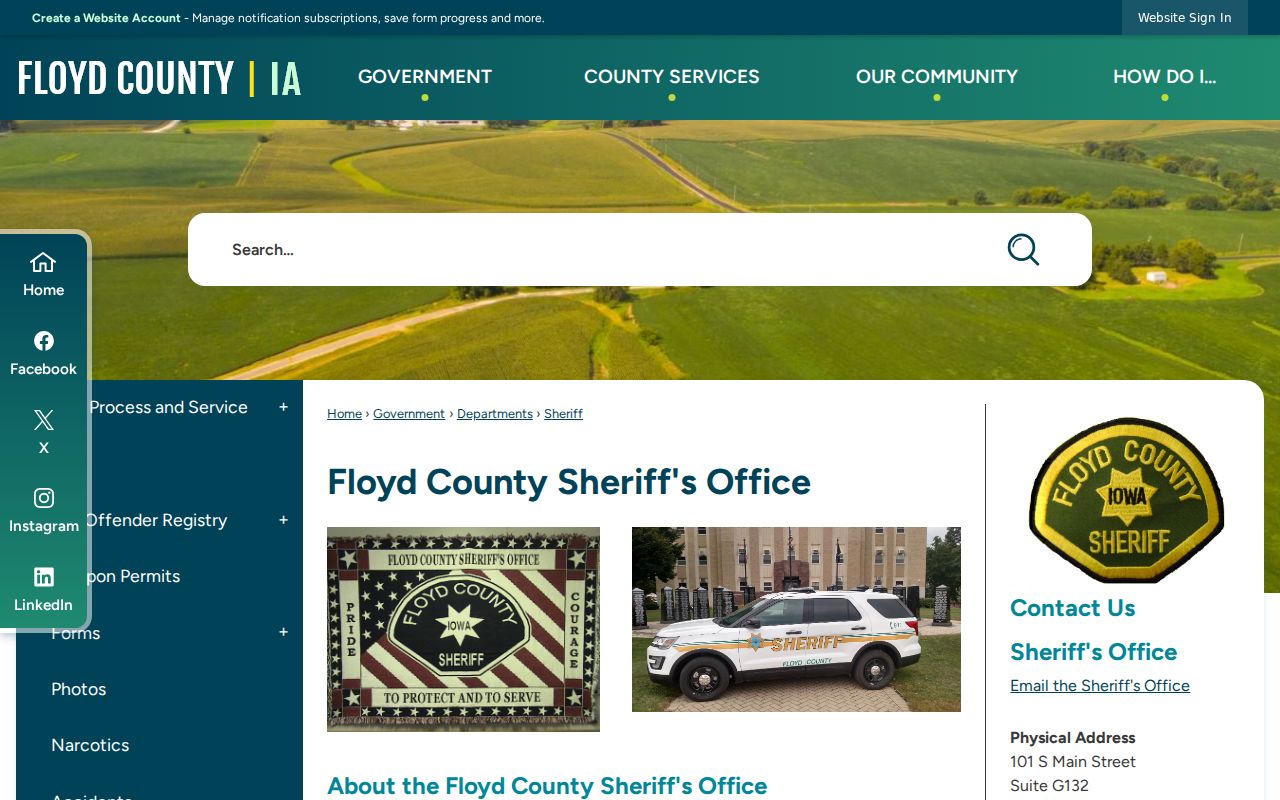
This office is the local source for sheriff reports, jail and booking records, fingerprint service, active county arrest warrants, and sex offender registration work.
Official Background Checks in Iowa
The Iowa Department of Public Safety, Division of Criminal Investigation, is the central repository. Its Iowa Record Check Online process is a request channel, not an anonymous instant-results database. A name-based check costs $15 for each last name searched. First name, last name, and exact date of birth are the minimum identifiers. Middle name and Social Security number can help distinguish a common name, while the current request form also asks for gender.
DCI accepts requests online, by mail, fax, email, or in person. It does not take them by telephone. Both the request form and billing form must be submitted. A former surname needs a separate paid search. Without the subject's signed release, DCI withholds completed deferred judgments and arrests more than 18 months old that have no final disposition. Most juvenile history is confidential.
| Official channel | Cost or access | Best use |
|---|---|---|
| Iowa Courts Online | Basic public index is free | Filed Floyd County cases and dispositions |
| Iowa DCI name check | $15 per last name | Releasable statewide fingerprint-backed history |
| Floyd County Sheriff | Copy fee not published | Local reports, bookings, custody, warrants, fingerprints |
| FBI self-review | Federal direct-request fee applies | A person's own national identity history summary |
The DCI criminal history instructions control the current forms, payment methods, and delivery choices.
That state page also explains why authorization and fingerprint reporting can change the answer returned for a Floyd County criminal record.
Floyd County DCI Record Limits
A DCI response stating “No Iowa Criminal History Found” is narrower than it sounds. It can mean that no fingerprint-supported history exists, that no information is releasable under the request and authorization supplied, or that the available material is confidential juvenile information. DCI states that every repository history begins with fingerprints. If an arresting agency did not take and submit them, the local event may never create a DCI cycle.
Reporting time matters too. Floyd County jail staff create the booking first. The County Attorney may later change or decline the arrest charge. The clerk reports the court disposition after a case moves forward. A DCI check and court docket can therefore describe the same event at different points. For self-review, the record subject can ask DCI to examine a disputed entry. The agency may require fingerprints to confirm identity before changing the file.
| Record | Primary custodian | What it answers |
|---|---|---|
| Incident or arrest report | Arresting agency | What officers recorded at the event |
| Booking sheet | Floyd County Sheriff | Intake, initial charge, bond, release or transfer |
| Court file | Floyd County Clerk | Filed counts, hearings, outcome and sentence |
| DCI history | Iowa DCI | Releasable fingerprint-linked Iowa arrest cycles |
Kinds of Criminal Records
Floyd County criminal records are created by the office doing the work. Charles City Police and Nora Springs Police retain their city reports. The sheriff holds rural and contract-town incident records, county bookings, and active Floyd County warrants. The Iowa Judicial Branch keeps the court file. DCI compiles reported arrest cycles and outcomes. Corrections records begin after a qualifying sentence or community-supervision placement.
- Arrest and booking records identify the agency action and county jail intake, not guilt.
- Court case files show filed charges, motions, pleas, dispositions, judgments, and sentences.
- Warrant records may appear in a docket, but the sheriff must confirm live status.
- Correctional records can show state custody or public supervision status after sentencing.
- Registry records publish statutory sex offender registration facts for safety use.
The Iowa Judicial Branch is the statewide entry point for Floyd County case information.

Its court directory, search help, forms, and public services connect Floyd County records to the unified Iowa District Court system.
Floyd County Jail Record Gaps
Floyd County publishes no searchable inmate roster, daily booking log, active warrant list, or verified sheriff app. That absence makes the fallback route important. Call the sheriff at 641-228-1821 for current custody and booking guidance, visit Suite G132 during weekday public hours, or make a focused Iowa Open Records Law request for a releasable booking sheet or jail log. Iowa Courts Online may show filed charges and bond orders, but it does not prove where a person is physically held now.
A sentenced person may move to Iowa Department of Corrections custody. VINELink can support custody-status notifications. Federal custody belongs in the Bureau of Prisons locator. A person released from Floyd County jail will no longer appear in a current-custody answer even though the booking, incident report, and court case may still exist. Always identify which custody layer the question concerns before treating a blank result as final.
Note: Floyd County has not published current visitation, mail, commissary, phone-vendor, or bond-payment instructions, so call before sending money or traveling.
Floyd County Criminal Records: What They Contain
A Floyd County criminal record can identify a person, event, charge, and outcome, but the field set depends on the source. An agency report may carry the narrative and incident number. A booking entry adds intake, fingerprints, initial charges, bond, and release. A court docket adds the filed case number, count-level disposition, orders, and sentence. A DCI rap sheet links the fingerprint-supported arrest cycle with outcomes reported back to the repository.
| Name and identifiers | Legal name, aliases, date of birth, and source-specific identity fields. |
|---|---|
| Arrest and booking | Agency, date, booking number, initial allegations, bond, custody, release, or transfer. |
| Charges and statutes | Arrest charges, filed counts, Iowa Code citations, and later amendments. |
| Disposition | Dismissal, acquittal, conviction, deferred judgment, transfer, or another count outcome. |
| Sentence | Confinement, probation, fines, costs, and other terms shown in the judgment. |
| Custody or supervision | Public jail, prison, probation, or parole status when the holding system publishes it. |
Never read “closed” as the disposition of every count. Open the final order when the legal result matters. The full charge and sentencing trail is covered in the Floyd County court case lookup.
Floyd County Warrant Record Checks
The Floyd County Sheriff says the office serves and maintains all active county arrest warrants, but no public live database is available. A court docket may show that a warrant was issued, served, recalled, or quashed. It is not a real-time law-enforcement status screen. Call the sheriff at 641-228-1821 and the clerk at 641-228-7777 with the related case number. Use urgent phone contact, not email, for a current status question.
An arrest warrant authorizes custody on an allegation. A bench warrant often follows a missed appearance or breach of an order. A search warrant authorizes a search and can remain sealed while an inquiry is active. If a Floyd County warrant appears, obtain the case and warrant identifiers, verify the issuing court, read the bond or appearance order, and seek legal advice about safe resolution. Keep any recall or satisfaction order until both court and law-enforcement systems reflect it.
Iowa Public Access Laws
The Iowa Open Records Law gives people a right to inspect and copy public records during customary office hours. It also permits reasonable actual costs and a reasonable delay to decide whether material is confidential. Criminal-history dissemination has separate rules. Court rules and case orders can restrict protected identifiers, sealed filings, and juvenile cases. An office need not create a new summary or answer questions when only existing records are subject to disclosure.
Key Iowa laws:
Iowa Code chapter 22 grants access to public records and governs reasonable costs, timing, and confidential categories.
Iowa Code chapter 692 governs criminal-history collection, access, challenges, and dissemination.
Iowa Code chapter 901C sets several Iowa expungement routes and limits.
Iowa Code chapter 692A controls sex offender registration, public access, duties, and restrictions.
Ask the custodian to release reasonably segregable public parts and cite the legal ground for each withholding. Request an estimate before chargeable search, review, copying, or redaction work begins.
Floyd County Custody Record Routes
Local jail custody, state correctional custody, community supervision, and federal custody use different systems. The Floyd County Sheriff answers the local booking question. Iowa DOC publishes an offender search for state custody and public status. The Second Judicial District Department of Correctional Services serves Floyd County probation and parole supervision, while the Iowa Board of Parole makes parole decisions. The sentencing docket remains the best public evidence that probation was imposed.
The Second Judicial District corrections page identifies the district layer serving Floyd County.
Operational supervision notes, risk assessments, treatment data, and protected personal details are not the same as a public court judgment.
The Iowa Board of Parole supplies the separate parole-decision source.
Use Board records for release decisions and Iowa DOC records for supervision, rather than treating either as a Floyd County jail roster.
Restricted, Sealed & Expunged Records
Iowa uses the term expungement, but no single rule erases every Floyd County criminal record. Chapter 901C covers acquittals, dismissals, and a limited route for qualifying misdemeanor convictions. The misdemeanor route generally requires more than eight years, no pending charges, compliance with financial obligations, and an eligible offense. Many offenses are excluded. Most juvenile court material is confidential under chapter 232.
A discharged deferred judgment shows why the systems must be checked separately. The court-level case may be expunged, while DCI keeps the event marked as a discharged non-conviction and releases it only when Iowa law allows. An Iowa order also does not erase a federal docket. A person reviewing a cleared record should obtain the Floyd County order, verify the court display, review the DCI self-record, and use DCI's dispute route if the repository entry is wrong.
- Dismissed
- The count ended without a conviction in that proceeding.
- Deferred judgment
- The court defers judgment; successful discharge is a non-conviction with special DCI treatment.
- Expunged
- The record becomes confidential under the specific Iowa law and order that applies.
- Sealed
- Public access is blocked by law or court order, though authorized access may remain.
Floyd County Registry Record Layer
The Iowa Sex Offender Registry is a safety-notification system, not a full Floyd County criminal history. It can show public identity, address or work information, photograph, qualifying offense, tier, status, and other statutory fields. Floyd County also publishes a current county SOR list, but the state profile is the stronger source for current status and detail.
The Iowa Sex Offender Registry added broader searches, maps, notifications, and safety resources in its 2025 redesign.
Use registry records for lawful personal, family, and community safety. The Floyd County sex offender lookup explains the search fields, tiers, and local registration office.
Floyd County Criminal Record Terms
Small wording differences change the meaning of a Floyd County criminal record. An arrest is a custody event. A charge is an accusation. A disposition is the result of one count. A sentence follows a conviction or other qualifying judgment. A docket is an event index, not always the full clerk file. “No record” can describe only the product and release rules searched.
Federal matters add another layer. Floyd County lies in the Northern District of Iowa, and PACER is the official federal docket system. Federal custody appears through the Bureau of Prisons, not Iowa DOC or the Floyd County jail.
The PACER service is the official federal case-search channel.
Registration, current judiciary fees, sealed-case limits, and federal document access rules apply independently of Iowa court access.
City-by-City Criminal Records in Floyd County
City location determines the first Floyd County criminal records custodian. Charles City and Nora Springs have police departments, while Rockford receives contracted law enforcement from the sheriff. Nora Springs crosses the Floyd and Cerro Gordo county line, so a case may be filed outside Floyd County. All three lack a separate municipal criminal court; filed Floyd matters enter the unified Iowa District Court system.
Charles City Record Check
Population 7,396. City police keep incident records, while county offices keep bookings and court cases.
Nora Springs Record Check
Population 1,369. Confirm the county side, police custodian, receiving jail, and filing court.
Rockford Record Check
Population 758. The Floyd County Sheriff supplies policing under a 28E agreement.